Innovations in Contemporary Cognitive Behavioral Therapy (CBT): Clinical Practice and Documentation
About This Series:
As clinicians, many of us are trained in a limited number of psychotherapy approaches, yet over time our clinical work often expands to include a broader range of therapeutic modalities and client needs. This series explores contemporary psychotherapy approaches, with a focus on their clinical applications, therapeutic interventions, and documentation in practice.
While each modality – such as cognitive behavioral therapy (CBT), psychodynamic therapy, EMDR, Internal Family Systems (IFS), and others – has its own theoretical foundation, there is often meaningful overlap in the core therapeutic processes they address, including emotion regulation, relational patterns, attachment, trauma, insight, and behavioral change. Many recent developments in psychotherapy also reflect a growing integration of ideas across approaches, including mindfulness-based, somatic, neurobiological, and acceptance-oriented perspectives.
As clinicians, we may also find ourselves drawn toward particular therapeutic approaches based on our training, clinical style, client populations, or evolving professional interests. At the same time, it can be valuable to remain open to models that may be less familiar or less represented within our original training backgrounds.
This series is written from a clinician’s perspective to support ongoing professional learning, thoughtful reflection, and the development of clear, meaningful clinical documentation. The goal is not to promote any single orientation, but to encourage an integrative and clinically grounded approach to psychotherapy practice.
Introduction: The Evolution of CBT in Clinical Practice
General Description: Cognitive Behavioral Therapy (CBT) is a structured, evidence-based psychotherapy approach that helps individuals identify and modify patterns of thinking, emotion, and behavior that contribute to psychological distress. CBT focuses on the relationship between thoughts, feelings, and actions, helping patients develop more adaptive coping strategies, emotional regulation skills, and problem-solving abilities.
Cognitive Behavioral Therapy remains one of the most widely practiced and empirically supported approaches in psychotherapy. However, contemporary CBT has evolved well beyond its earlier, highly structured and protocol-driven forms. While traditional CBT emphasized the identification and modification of distorted cognitions, current practice reflects a broader, more flexible understanding of how thoughts, emotions, behaviors, and contextual factors interact.
Increasingly, CBT is practiced within a process-based and integrative framework, where interventions are selected not solely on the basis of diagnosis, but in response to underlying psychological processes such as avoidance, cognitive rigidity, emotional dysregulation, and maladaptive belief systems.
For clinicians, this evolution introduces an important parallel task: documenting CBT work in a way that captures clinical reasoning, process, and patient response, rather than reducing the work to generic or formulaic descriptions.
The Shift Toward Process-Based CBT
One of the most significant developments in contemporary CBT is the move toward process-based therapy, an approach influenced by work from Steven C. Hayes and others. Rather than organizing treatment around diagnostic categories (e.g., CBT for depression, CBT for anxiety), clinicians increasingly focus on targeting core psychological processes that cut across diagnoses.
These processes may include:
- cognitive fusion and rigid thinking patterns
- experiential avoidance
- attentional bias
- maladaptive core beliefs
- deficits in emotional regulation
This shift allows for greater flexibility in treatment and supports individualized clinical decision-making. Traditional CBT techniques—such as cognitive restructuring, behavioral activation, and exposure—are still used, but with increased attention to their function within the patient’s broader psychological system.
Expanding the Role of Emotion in CBT
Earlier forms of CBT were sometimes criticized for prioritizing cognition over emotional experience. Contemporary CBT has responded by integrating:
- emotion-focused strategies
- greater tolerance of affective states
- attention to meaning-making and subjective experience
In practice, clinicians may:
- spend more time engaging directly with emotional activation
- explore the adaptive function of emotional responses
- incorporate acceptance-based and mindfulness-informed strategies
This results in a more balanced approach that addresses both cognitive and emotional dimensions of distress.
Clinical Application: Flexibility in Practice
In contemporary CBT, sessions are often less rigidly structured than traditional models might suggest. While agenda setting, homework, and skill-building remain important, clinicians frequently adapt their approach based on the patient’s immediate presentation.
Clinical work may involve:
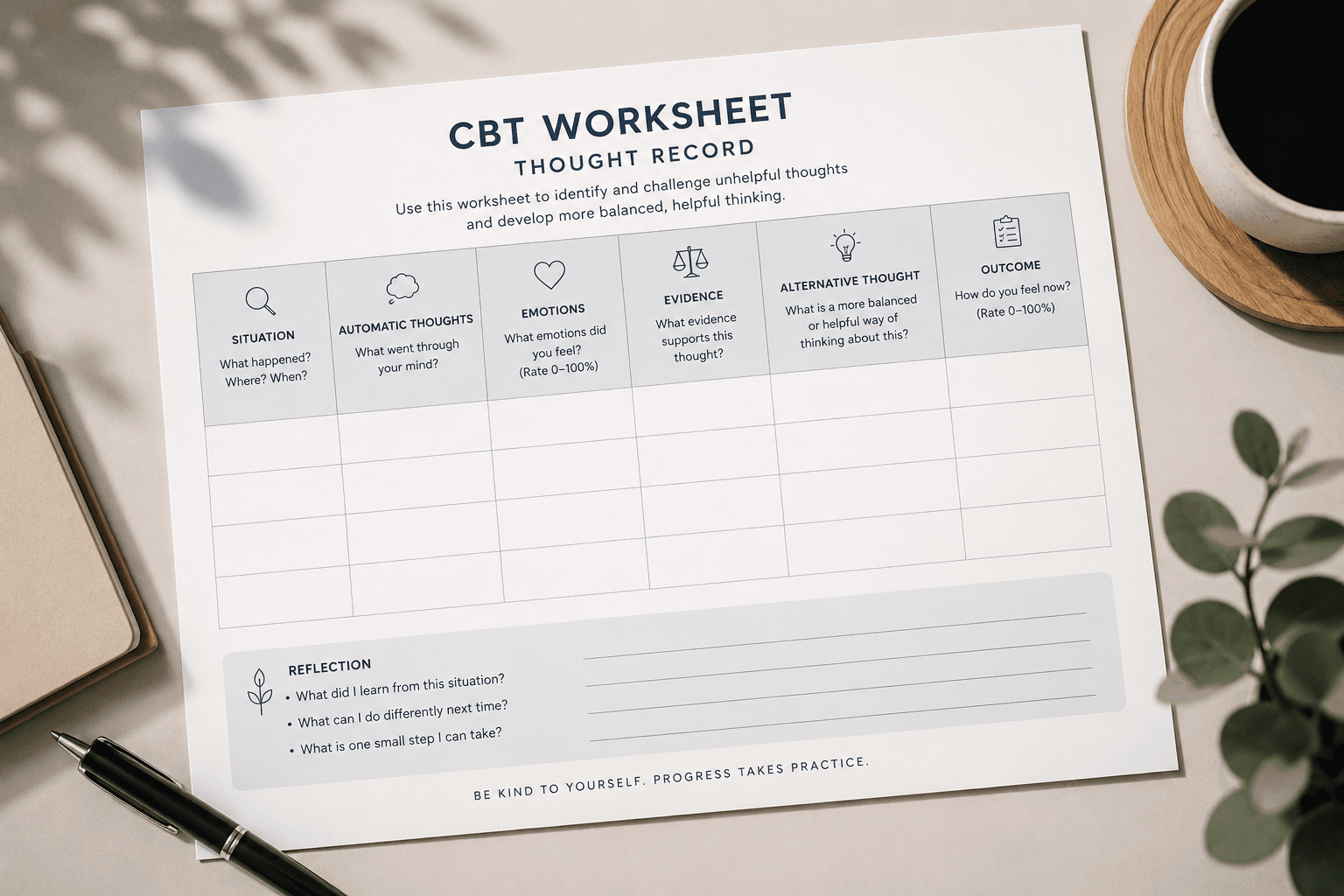
- identifying and exploring automatic thoughts in context
- collaboratively designing behavioral experiments
- addressing avoidance patterns through graded exposure
- strengthening coping strategies and emotional regulation
These interventions align with structured domains such as:
- cognitive restructuring and thought evaluation
- behavioral interventions and exposure techniques
- emotion regulation and coping strategies
- relaxation and mindfulness-based techniques
- goal setting and treatment planning
Rather than applying techniques in a prescriptive manner, clinicians move fluidly between interventions, guided by the patient’s needs and therapeutic goals.
Integration with Third-Wave and Related Approaches
Contemporary CBT is increasingly integrated with so-called “third-wave” approaches, including Acceptance and Commitment Therapy (ACT), mindfulness-based cognitive therapy (MBCT), and compassion-focused therapy.
This integration has led to:
- greater use of acceptance-based strategies
- incorporation of mindfulness practices
- increased focus on psychological flexibility
For example, rather than challenging a thought solely on the basis of accuracy, a clinician might also explore:
- the impact of the thought on behavior
- the degree of attachment to the thought
- the possibility of observing the thought without reacting to it
These developments reflect a broader trend toward flexibility, integration, and responsiveness in CBT practice.
Documentation in Contemporary CBT Practice
As CBT becomes more nuanced, documentation must evolve accordingly.
A common limitation in clinical documentation is the use of overly generic phrases such as:
“CBT techniques were used to challenge negative thinking.”
While technically accurate, this does not convey:
- the specific intervention used
- the process targeted
- the patient’s response
Effective CBT documentation should reflect:
- the underlying process (e.g., avoidance, rumination, cognitive distortion)
- the intervention applied
- the patient’s engagement and response
For example, documentation may include:
- identification of automatic thoughts and their functional impact
- use of behavioral experiments to test beliefs
- implementation of exposure strategies to reduce avoidance
- development of coping strategies to enhance emotional regulation
Sample CBT Intervention Language
cognitive behavioral interventions focused on identifying patterns of automatic negative thoughts contributing to emotional distress
interventions targeted maladaptive belief systems through structured cognitive restructuring and evaluation
behavioral interventions included development and implementation of graded exposure to reduce avoidance
interventions emphasized increasing awareness of the relationship between thoughts, emotions, and behaviors
coping strategies were introduced to support emotional regulation and stress management
goal-setting interventions focused on enhancing self-efficacy and reinforcing adaptive behaviors
cognitive interventions were integrated with mindfulness-based strategies to increase psychological flexibility
homework assignments were collaboratively developed to reinforce skill acquisition and generalization
Integrating Clinical Practice with Documentation
With Note Designer, clinicians have access to up-to-date CBT intervention content that reflects both traditional cognitive-behavioral techniques and contemporary developments in process-based and integrative approaches.
This is particularly valuable:
- for experienced CBT clinicians, who want documentation language that captures nuance and clinical reasoning
- for clinicians in training or those using CBT more intermittently, who benefit from structured, clinically grounded phrasing
By supporting more precise and flexible documentation, Note Designer helps ensure that progress notes accurately reflect the complexity of modern CBT practice.
Clinical Reflection
Contemporary CBT represents a significant evolution from its earlier, more structured forms. While its core principles remain intact, the approach has become increasingly flexible, integrative, and responsive to the complexities of real-world clinical practice.
For clinicians, this requires not only adapting interventions, but also refining how clinical work is conceptualized and communicated. Documentation plays an important role in this process, serving as a record not only of what was done, but of how and why it was done.
Capturing this level of nuance supports continuity of care, enhances clinical clarity, and reflects the depth of the therapeutic process.
Recommended Readings
Beck, J. S. (2020). Cognitive Behavior Therapy: Basics and Beyond (3rd ed.). Guilford Press.
A foundational and widely used text that introduces the core principles and contemporary practice of CBT. Essential for grounding clinical practice while adapting to contemporary developments.
Dobson, K. S., & Dozois, D. J. A. (Eds.). (2019). Handbook of Cognitive-Behavioral Therapies (4th ed.). Guilford Press.
A comprehensive and clinically sophisticated overview of CBT approaches across a wide range of disorders and applications. Useful for clinicians seeking depth and breadth in contemporary CBT practice.
Kuyken, W., Padesky, C. A., & Dudley, R. (2009). Collaborative Case Conceptualization: Working Effectively with Clients in Cognitive-Behavioral Therapy. Guilford Press.
A clinically rich guide emphasizing individualized formulation and collaborative treatment planning—central elements of modern CBT.
Greenberger, D., & Padesky, C. A. (2015). Mind Over Mood: Change How You Feel by Changing the Way You Think (2nd ed.). Guilford Press.
Although often used as a client workbook, this resource provides structured exercises that clinicians can adapt for in-session use and skill development.